OpenCL is the new open standard for GPGPU (general-purpose computing on graphics processing units) programming. It supports both graphics cards and multi-core processors with the same C99-based source code. I've re-written the NVIDIA CUDA version of my real-time ray tracer using OpenCL, and run it on an ATI/AMD Radeon HD 5870 GPU. For comparison I also ran it in CPU mode on the Intel i7-980X (6 core, hyperthreaded) processor.
The OpenCL CPU version provided similar results to the pthreads-generic version tested earlier. With 10 objects in the scene the GPU performance was only slightly better than the CPU version. But as the number of objects increased the GPU version maintained performance much better than the CPU version. This indicates that with low object counts the actual work done by each GPU core is small relative to the setup and copying results back overheads. Yes, a realistic ray tracer would be culling the scene graph so fewer objects would be evaluated for each point. And the GPU version ran out of constant memory above 800 objects. But this is much better scaling and performance than the NVIDIA CUDA test I did a few years ago.
Showing posts with label ray tracing. Show all posts
Showing posts with label ray tracing. Show all posts
Monday, November 1, 2010

Sunday, October 24, 2010
Hyper-Threading
I've re-run my real-time ray tracing and Go ACO TSP programs on a 6 core processor with hyper-threading. The Intel i7-980X supports two hardware threads per core, so the OS sees it as a 12-core processor.
Here hyper-threading has improved performance for both programs in all configurations. At one core both programs were sped up 28%. At 6 cores ray tracing was sped up 9% versus non-HT, while ACO TSP was sped up 18% versus non-HT. The higher speedup for ACO TSP is expected as it matches the general speedup from increased cores.
Both programs were run with 24 threads in all test configurations. Having more program threads than cores*hardware_threads_per_core is key. Otherwise the OS may schedule multiple threads on the same core while leaving others idle. Linux is hyper-theading aware and attempts to avoid this scheduling problem, but doesn't always get it right. In testing with 6 threads and 6 cores, I saw 28% decreases in performance for both programs when hyper-threading was enabled.
The Intel i7-980X also supports "Turbo Boost", where one core is automatically overclocked when other cores are idle. Turbo boost was disabled for the tests above. With one core and HT disabled, Turbo boost provides a speedup of 8% for both programs. Surprisingly, with six cores and HT enabled (so all cores should be fully utilized) Turbo boost provides a speedup of 5% for both programs.
The performance of Go has also improved relative to the single-threaded C version of ACO TSP. For 24 ants the C version finishes in 60 seconds, so on one core Go is only 1.7x slower than C. At 2 cores Go has exceeded the performance of the single-threaded C version. Previously Go was 2.8x slower than C on one core; I don't know whether this improvement is due to an improved Go compiler, the move to 64-bit compilers and OS, or architectural differences between the Intel Core 2 and i7-980X.
Sunday, January 18, 2009
CUDA GPGPU on MacBook Pro Laptop
I've ported my pthread generic and CUDA GPGPU real-time ray tracers to Mac OS X running on a MacBook Pro laptop. It has a 2.4GHz Intel Core 2 Duo processor and a NVIDIA GeForce 9600M GT graphics processor. The Performance for 1 and 2 software threads is comparable to my older Linux desktop, and the CUDA is within a factor of 3 of the desktop graphics card.
Threads    Frames Per Second
1           8.5
2          17.4
GPU        16.7
Monday, July 21, 2008
Citations and Uses of Ray Tracer Code
The real-time ray tracing code I wrote for PS3 Cell and CUDA GPGPU is being used by others. David Yuen's group at the Department of Geology and Geophysics and Minnesota Supercomputing Institute at the University of Minnesota used my PS3 code as the starting point for tsunami modeling. From their IEEE Vis 2007 poster session Use of Ray Tracing Techniques on Tsunami Simulation Data with the PlayStation® 3:
"This poster will discuss how we have used the PlayStation® 3’s cell processor to implement and employ parallelized visualization, through the form of ray tracing techniques, on tsunami data. By adapting Eric Rollins’ ray tracing package, we were able to implement his ray casting techniques on triangles. This allowed us to triangulate our tsunami datasets, stored as [x, y, height] data, and feed the triangulated data into the program. We rendered 4000 triangle objects from the data and applied a colormap based on each triangle’s height value. Finally, we displayed the generated image."
They also published a paper Experiments in scientific computation on the PlayStation 3 in the Springer journal Visual Geosciences. This PowerPoint presentation shows images from my and their work.
Other students are trying CUDA GPGPU ray tracing. Michael Allgyer (DOC) cited my work in his masters thesis proposal. Umut Erturk asked me about PS3 versus GPGPU for his thesis. Others are trying to get my CUDA code working on windows.
"This poster will discuss how we have used the PlayStation® 3’s cell processor to implement and employ parallelized visualization, through the form of ray tracing techniques, on tsunami data. By adapting Eric Rollins’ ray tracing package, we were able to implement his ray casting techniques on triangles. This allowed us to triangulate our tsunami datasets, stored as [x, y, height] data, and feed the triangulated data into the program. We rendered 4000 triangle objects from the data and applied a colormap based on each triangle’s height value. Finally, we displayed the generated image."
They also published a paper Experiments in scientific computation on the PlayStation 3 in the Springer journal Visual Geosciences. This PowerPoint presentation shows images from my and their work.
Other students are trying CUDA GPGPU ray tracing. Michael Allgyer (DOC) cited my work in his masters thesis proposal. Umut Erturk asked me about PS3 versus GPGPU for his thesis. Others are trying to get my CUDA code working on windows.
Saturday, April 5, 2008
Progress in GPGPU Ray Tracing
I've been getting traffic and questions about my pages on Cell and CUDA ray tracing. Saarland University has been doing some interesting work on Cell and CUDA ray tracing including this paper: Realtime Ray Tracing on the GPU with BVH-based Packet Traversal.
Sunday, December 2, 2007
OpenMP
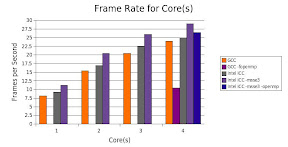
Intel C++ supports OpenMP, a standardized API for shared-memory multiprocessing in C++. By adding a simple #pragma loops can be split up to automatically run in parallel on multiple cores. I added a simple change to the per-screen-line rendering loop of my generic ray tracer:
With this change each pixel is rendered by a separate thread, with a maximum of 4 (the number of cores) running simultaneously. This use of threads is an alternative to the explicit pthread threading tested previously, where a separate thread was used per line of the screen. In this case OpenMP is simpler than explicit threading, though it yields slightly lower performance.
GCC 4.2 also supports OpenMP, but its performance is much worse than Intel.
    int screenX;
#ifdef USE_OMP
#pragma omp parallel for firstprivate(portPoint)
#endif
    for (screenX = 0;
         screenX < SCREEN_WIDTH;
         screenX++) {
With this change each pixel is rendered by a separate thread, with a maximum of 4 (the number of cores) running simultaneously. This use of threads is an alternative to the explicit pthread threading tested previously, where a separate thread was used per line of the screen. In this case OpenMP is simpler than explicit threading, though it yields slightly lower performance.
GCC 4.2 also supports OpenMP, but its performance is much worse than Intel.
Monday, July 16, 2007
Intel C++ Compiler
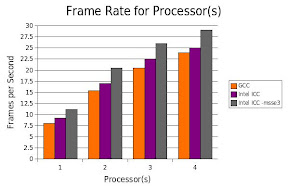
I recompiled my generic Ray Tracer code using the Intel C++ compiler. Using SSE3 auto-vectorization I obtained a 21% speedup over GCC.
Wednesday, July 4, 2007
Cell PPC Hardware Threads
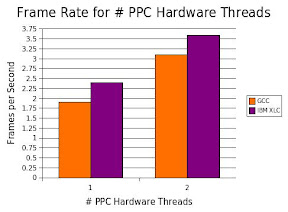
The PowerPC unit in the PS3 Cell processor supports two hardware threads. Earlier I added pthread support to the generic ray tracer code. I have updated Real-Time Ray Tracing on the Playstation 3 Cell Processor with PPC performance measurements with pthreads and the IBM XLC compiler. Pthreads gives a 63% speedup, and XLC gives a 26% speedup, and together they give an 89% speedup:
Sunday, July 1, 2007
CUDA GPGPU and Pthreads
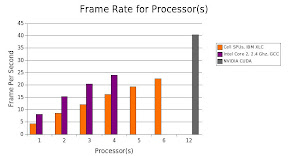
I've added a new page, Real-Time Ray Tracing with NVIDIA CUDA GPGPU and Intel Quad-Core. I've created two new versions of the ray-tracer code, one utilizing NVIDIA CUDA, and another using pthreads to exercise multi-core CPUs. The CUDA code is fastest, but least realistic as a practical ray-tracer. Pthreads was certainly easiest -- a half hour change to pre-existing generic code. I think CUDA will perform much better on more constrained (in terms of control flow and random memory access) algorithms.
Saturday, June 9, 2007
PS3 Cell SDK 2.1
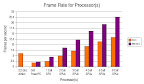
I've been getting some compatibility questions about my PS3 Ray Tracer code, so I just upgraded my PS3 to Fedora Core 6 and Cell SDK 2.1. IBM changed the SPU thread API (to pthreads); I now provide code for both versions. They also now have a PPC native version of the IBM XLC compiler. It provides an over 50% performance improvement over GCC:
Wednesday, May 2, 2007
PS3 Cell Ray Tracing at MIT, GPGPU at UI
Earlier this year I wrote an article on Real-Time Ray Tracing on the Playstation 3 Cell Processor. MIT is offering a course on Multicore Programming on the PS3. One of the examples presented is the Blue Steel Ray Tracer.
Earlier I also wrote an article on Four-Dimensional Cellular Automata Acceleration Using GPGPU. The University of Illinois at Urbana-Champaign is offering a course on Programming Massively Parallel Processors featuring GPGPU programming on NVIDIA CUDA hardware.
Currently applications must be written specifically for the Cell, conventional multi-core CPUs, or GPGPU. Several organizations are working to develop a common programming model where the same application code could be compiled to run on any of these. One such system is from RapidMind. It's programming model is much like the use of OpenGL within a C++ program. Arrays are defined using RapidMind container types (like OpenGL graphical types), and then embedded programs are invoked on them (like OpenGL Shading Language).
Earlier I also wrote an article on Four-Dimensional Cellular Automata Acceleration Using GPGPU. The University of Illinois at Urbana-Champaign is offering a course on Programming Massively Parallel Processors featuring GPGPU programming on NVIDIA CUDA hardware.
Currently applications must be written specifically for the Cell, conventional multi-core CPUs, or GPGPU. Several organizations are working to develop a common programming model where the same application code could be compiled to run on any of these. One such system is from RapidMind. It's programming model is much like the use of OpenGL within a C++ program. Arrays are defined using RapidMind container types (like OpenGL graphical types), and then embedded programs are invoked on them (like OpenGL Shading Language).
Subscribe to:
Posts (Atom)