The real-time ray tracing code I wrote for PS3 Cell and CUDA GPGPU is being used by others. David Yuen's group at the Department of Geology and Geophysics and Minnesota Supercomputing Institute at the University of Minnesota used my PS3 code as the starting point for tsunami modeling. From their IEEE Vis 2007 poster session Use of Ray Tracing Techniques on Tsunami Simulation Data with the PlayStation® 3:
"This poster will discuss how we have used the PlayStation® 3’s cell processor to implement and employ parallelized visualization, through the form of ray tracing techniques, on tsunami data. By adapting Eric Rollins’ ray tracing package, we were able to implement his ray casting techniques on triangles. This allowed us to triangulate our tsunami datasets, stored as [x, y, height] data, and feed the triangulated data into the program. We rendered 4000 triangle objects from the data and applied a colormap based on each triangle’s height value. Finally, we displayed the generated image."
They also published a paper Experiments in scientific computation on the PlayStation 3 in the Springer journal Visual Geosciences. This PowerPoint presentation shows images from my and their work.
Other students are trying CUDA GPGPU ray tracing. Michael Allgyer (DOC) cited my work in his masters thesis proposal. Umut Erturk asked me about PS3 versus GPGPU for his thesis. Others are trying to get my CUDA code working on windows.
Showing posts with label PS3 Cell. Show all posts
Showing posts with label PS3 Cell. Show all posts
Monday, July 21, 2008

Wednesday, July 4, 2007
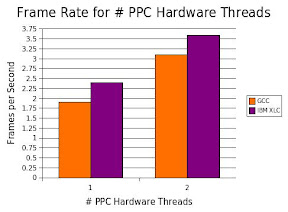
Cell PPC Hardware Threads
The PowerPC unit in the PS3 Cell processor supports two hardware threads. Earlier I added pthread support to the generic ray tracer code. I have updated Real-Time Ray Tracing on the Playstation 3 Cell Processor with PPC performance measurements with pthreads and the IBM XLC compiler. Pthreads gives a 63% speedup, and XLC gives a 26% speedup, and together they give an 89% speedup:
Saturday, June 9, 2007
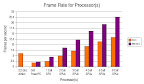
PS3 Cell SDK 2.1
I've been getting some compatibility questions about my PS3 Ray Tracer code, so I just upgraded my PS3 to Fedora Core 6 and Cell SDK 2.1. IBM changed the SPU thread API (to pthreads); I now provide code for both versions. They also now have a PPC native version of the IBM XLC compiler. It provides an over 50% performance improvement over GCC:
Wednesday, May 2, 2007
PS3 Cell Ray Tracing at MIT, GPGPU at UI
Earlier this year I wrote an article on Real-Time Ray Tracing on the Playstation 3 Cell Processor. MIT is offering a course on Multicore Programming on the PS3. One of the examples presented is the Blue Steel Ray Tracer.
Earlier I also wrote an article on Four-Dimensional Cellular Automata Acceleration Using GPGPU. The University of Illinois at Urbana-Champaign is offering a course on Programming Massively Parallel Processors featuring GPGPU programming on NVIDIA CUDA hardware.
Currently applications must be written specifically for the Cell, conventional multi-core CPUs, or GPGPU. Several organizations are working to develop a common programming model where the same application code could be compiled to run on any of these. One such system is from RapidMind. It's programming model is much like the use of OpenGL within a C++ program. Arrays are defined using RapidMind container types (like OpenGL graphical types), and then embedded programs are invoked on them (like OpenGL Shading Language).
Subscribe to:
Posts (Atom)