Showing posts with label evolution. Show all posts

Sunday, July 29, 2012

Bumpass Hell

(Sulphur Works)

Bumpass Hell is a part of Lassen Volcanic National Park in northern California. It is named for the unfortunate guide Mr. Bumpass, who lost his leg after he broke through the crust on a boiling mud pot. Today this area is being used as a natural laboratory to investigate conditions for the original origin of life on Earth. David Deamer, author of First Life: Discovering the Connections between Stars, Cells, and How Life Began is one such researcher.

Sunday, October 2, 2011

Evolution as Scientific Method, and Vice Versa

Evolution can be viewed as an implementation of the scientific method by nature. In each generation mutation and genetic recombination produce varied hypothesis (individuals), and these hypothesis are tested in the environment [sample hypothesis: a small-beaked Darwin's Finch is better suited to the food available on this island]. Those hypothesis which best survive this natural selection will produce new generations of hypothesis to be tested (differential reproduction). Hypothesis which are unsuccessful in the natural environment will die out.

Alternately the scientific method can be viewed as an implementation of evolution by man. Scientists generate variations of existing hypothesis, and subject these individual hypothesis to testing in the laboratory environment. The hypothesis which survive this testing will be used to generate new hypothesis. Hypothesis which are unsuccessful in the laboratory environment will die out.

This duality is most clearly seen in the use of techniques such as genetic algorithms in computer programming. Here analogues to mutation and genetic recombination are used to automatically generate new hypothesis from previous generations, and the "environment" consists of a fitness function that represents whatever problem is being optimized.

Sunday, December 12, 2010

Darwinism and Authority

American critics of evolutionary theory often prefer to use the term "Darwinism". In doing so they reveal the philosophical, psychological, and theological underpinnings of their world-view: the argument from authority
Appeal to authority is a fallacy of defective induction, where it is argued that a statement is correct because the statement is made by a person or source that is commonly regarded as authoritative.
Scientists don't believe the theory of evolution is correct because it was originally formulated by Charles Darwin, or because it was presented in his book "The Origin of Species by Means of Natural Selection".

Scientific presentations of new theories consist of two parts: the theory itself, and the gathered data which this theory explains. The availability of the gathered data means other scientists can check its validity and see whether it actually supports the proposed theory, or matches some other theory better. For example, the finches Darwin gathered in the Galapagos islands are actually still stored in the bird collection of the British Natural History Museum. Additionally, future scientists can gather additional data and perform new experiments to confirm, expand on, or refute Darwin's original theories. So far new gathered data has confirmed Darwin's basic theories, and vastly expanded on them (understandable, since Darwin was not even aware of Mendelian genetics, let alone DNA). But this new research is not being done to defend Darwin's legacy. Young scientists would be overjoyed to discover a radical new experimental finding or theory which overturns Darwin, and are feverishly looking for this. This very possibility of being wrong is what makes evolution a scientific theory.

An earlier post quoted Dawkins on how children are natural essentialists. I argue children are also, both by nature and nurture, believers in the argument from authority. Children want all statements to have invariant mappings to the categories "true" or "false". The vague category "as best we can tell right now, pending future information" is confusing and upsetting. Teachers and parents are also natural authority figures, and don't have the time (and often background) to explain the rationale behind all their instructions. Elementary memorization is useful, and a child which questioned everything would be impossible to teach. But for many students this attitude continues to their study of science, so Newton, and Einstein, and Darwin become unquestioned authority figures. They don't go back to see that these scientist's work consisted of the same type of presentation discussed above: theories with supporting evidence.

Critics of "Darwinism" are often actually modeling their critique on their early childhood religious upbringing. Early authority figures in their life (their parents) presented additional authority figures (church leaders) whose authority is ultimately derived from an unquestionable final authority figure (the religion's founder(s)). The founders words are contained in unquestionable texts (the revealed sacred documents), and all necessary truths can be obtained through detailed study of those texts. This technique of finding truths through interpretation of texts written by founders (and later texts written about texts written by founders) can arguably be useful in some fields such as law. But it is of only historical interest in science. The correctness of modern evolutionary theory is not bound up in the life of Darwin or the text of "The Origin of Species."

An amusing collision between intelligent design "science" and argument from religious authority is here. Dembski is at risk of being "Expelled"...

Sunday, December 20, 2009

Science Fiction Physics, and Biology

The January 2010 Scientific American article "Looking for Life in the Multiverse" analyzes how much the laws of physics might differ while some form of life is still possible. It specifically shows that carbon-based life is still possible when the weak nuclear force is eliminated. The authors are less supportive of non-carbon-based life popular in science fiction, and still find support for the anthropic principle ("conditions that are observed in the universe must allow the observer to exist") in the precise value required for the cosmological constant.

Also, in an earlier post I claimed that all life on earth is dependent on the sun for energy. This is incorrect. The black smoker sea vents on the ocean floor support complete ecosystems including archaea, clams, and tubeworms. Here the energy comes from the interior of the earth instead of the sun.

Monday, December 14, 2009

Science Fiction Morality

In an earlier post I questioned the existence of atheist essentialist philosophers. I had been looking in the area of Philosophy of Science. Turns out a better place to look is Moral Philosophy. Moral Philosophy presents a moral spectrum, from Moral Nihilism (nothing is moral or immoral), to Moral Relativism (morals are relative to individual, social, cultural, or historic circumstances), to Moral Universalism (applies to "all similarly situated individuals") to Moral Realism (moral statements can be objectively true, and subject to rules of logic). In Moral Realism moral rules are similar to Platonic Forms or Ideals. Moral Realism is often grounded in religion, but is also supported by some atheist philosophers (example: Quentin Smith).

The boundaries between the positions are often fuzzy, with various proponents subtly repositioning other prominent philosophers. A historical stumbling block has been determining how a Universal Morality can be possible without recourse to a deity (and this is the basis of the "argument from morality", a proof of God's existence). More recently, based on research in Evolutionary Psychology, Steven Pinker wrote a great essay on how a human moral sense or instinct may have evolved. He presents many rules which are specific to the evolved nature of humans, and some which may be more universal. He says:

"Two features of reality point any rational, self-preserving social agent in a moral direction. And they could provide a benchmark for determining when the judgments of our moral sense are aligned with morality itself... One is the prevalence of nonzero-sum games. In many arenas of life, two parties are objectively better off if they both act in a nonselfish way than if each of them acts selfishly... The other external support for morality is a feature of rationality itself: that it cannot depend on the egocentric vantage point of the reasoner..."

It is interesting to consider how many rules the Moral Realist propose are universal, versus specific to the evolved nature of humans. I wonder how much science fiction Moral Realists read. A common theme in science fiction is the presentation of different alien races, and the different moral imperatives which naturally arise from their different evolutionary heritage. Examples are the K'kree (herbivores) and Hivers (one sex) from Traveller. And aside from other planets, we can similarly consider how morals would differ if radically different earth species (sharks? praying mantis? naked mole rats?) had evolved sentience. The Moral Realists imply that all creatures, regardless of evolutionary heritage, will always converge on the same universal morality (or that creatures which are unable to meet the standard can't achieve sentience). This may be a realistic assumption for a few of the meta-universals proposed by Pinker, but I don't think it applies to the much larger set of rules proposed by the Moral Realists. And without this universality the attempt to use rules of logic falls apart.

Sunday, December 6, 2009

The Fish Balance of Hobbiton

Like everyone else I've been trying to make sense of the arguments between the Keynesians, Austrians, etc. over the financial crisis. Lately I've been trying to puzzle out the National Financial Balance Accounting Identity:

Household FB + Business FB + Government FB + Foreign FB = 0

Described here. The importance of this equation is its use in justifying government deficits:

"We’ve said it before and we’ll say it again. As a matter of national accounting, the domestic private sector cannot increase savings unless and until foreign or government sectors increase deficits. Call this the tyranny of double entry bookkeeping: the government’s deficit equals by identity the non-government’s surplus." Marshall Auerback

From the first linked article, some definitions:

Financial Balance FB = income - expenditures, or saving - investment
income = profits + wages = P + W
spending = investment + consumption = I + C
normally (when FB=0) total income = total spending, so P +W = I + C

In discussing households we simplify by assuming no profits, so P=0

savings = W - C
FB = (W - C) - I

The author of the first linked article criticized an earlier author who claimed it was possible for all sectors Financial Balance to be simultaneously positive, so the Accounting Identity would not have to sum to zero. He claimed this would only be true in a primitive barter-based "Hobbit Shire".

Let's build one. Assume our world economy only consists of Hobbit households. No businesses, no government, no foreigners, no money, no outside investment. One primary resource: deep sea fish. Household "Wages" are the daily catch of fish. "Consumption" is eating fish. "Savings" is storing fish in the snow (Eskimo Hobbits :-) for later. So in good times (summer?) the net FB "Fish Balance" of all the Hobbit households is positive, while in bad times (winter?) the FB can be negative. This doesn't match the original Accounting Identity, but we can make it sum to zero by adding a new often-negative "Natural Resources" term to the equation.

Hobbit Household FB + Natural Resource FB = 0

This forms an interesting analogy to arguments against evolution based on the Second Law of Thermodynamics. Life on earth is not a closed system. It depends on a constant supply of energy from an outside source -- the sun. Life on earth is also dependent on heavier elements produced in prior supernovas. Similarly human economics is dependent on many raw material inputs which are not initially generated by (or often even owned by) humans. For the above Hobbit example I chose deep sea fish as a renewable resource owned by no-one. Other renewable resources include timber, food crops, textile crops, livestock, etc. Non-renewable resources include oil and minerals. Think AH Civilization or Settlers of Catan. And note these raw materials also ultimately come from the sun or supernovas.

This introduces the question of why the real Accounting Identity doesn't include a Natural Resources term. Obviously the real one is about money, not about resources. But if gathering natural resources creates value within the system, shouldn't it be represented? It is also not clear how many other aspects of value creation (such as a household purchasing an income-generating asset, rather than investing in the business sector) are represented.

This also brings up how new money is injected into the system. If the currency were gold-backed, money would be a resource. But a fiat currency is created by central banks. I assume the government deficit spending advocated in the quote above is fiscal spending, and the Government FB is budgetary spending. Alternately could they be advocating monetary stimulus, and the Government FB is that of the Federal Reserve? Does inflation matter in the equation, or is it irrelevant?

I think some of these questions are at the heart of the debates between the Keynesians and the Austrians. The Austrians focus on productive versus wasteful uses of resources, like my Hobbiton Fish Balance (to the extent they recognize the Financial Balance version they see it as an argument for returning to the resource-based gold standard). The Austrians claim recessons are caused by misallocation of resources. Keynesians are more focused on the flow (especially velocity) of money inside the Financial Balance Accounting Identity. Some claim our current problems are due to government not carrying out its proper role: running deficits.

Tuesday, October 6, 2009

Dawkins on Essentialism

For the mind encased in Platonic blinkers, a rabbit is a rabbit is a rabbit. To suggest that rabbitkind constitutes a kind of shifting cloud of statistical averages, or that today's typical rabbit might be different from the typical rabbit of a million years ago or the typical rabbit of a million years hence, seems to violate an internal taboo. Indeed, psychologists studying the development of language tell us that children are natural essentialists. Maybe they have to be if they are to remain sane while their developing minds divide things into discrete categories each entitled to a unique noun. It is no wonder that Adam's first task, in the Genesis myth, was to give all the animals names.

And it is no wonder, in Mayr's view, that we humans had to wait for our Darwin until well into the nineteenth century. To dramatize how very anti-essentialist evolution is, consider the following. On the 'population-thinking' evolutionary view, every animal is linked to every other animal, say rabbit to leopard, by a chain of intermediates, each so similar to the next that every link could in principle mate with its neighbors in the chain and produce fertile offspring. You can't violate the essentialist taboo more comprehensively than that. And this is not some vague thought experiment confined to the imagination. On the evolutionary view, there really is a series of intermediate animals connecting a rabbit to a leopard, every one of whom lived and breathed, every one of whom would have been placed in exactly the same species as its immediate neighbors on either side in the long, sliding continuum. Indeed, every one of the series was the child of its neighbor on one side and the parent of its neighbor on the other...


Richard Dawkins, The Greatest Show on Earth: The Evidence for Evolution, p. 23-24.

Tuesday, October 28, 2008

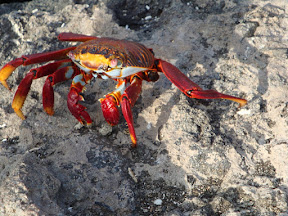
Galapagos


From Galapagos October 2008

Did the First Giraffe Have a Navel, Revisited

In an earlier post I asked, "Did the First Giraffe Have a Navel?". Turns out this is an old question:

These authors seem no more startled at a miraculous act of creation than at an ordinary birth. But do they really believe that at innumerable periods in the earth's history certain elemental atoms have been commanded suddenly to flash into living tissues? Do they believe that at each supposed act of creation one individual or many were produced? Were all the infinitely numerous kinds of animals and plants created as eggs or seed, or as full grown? and in the case of mammals, were they created bearing the false marks of nourishment from the mother's womb? The Origin of Species, By Charles Darwin (1859)

Sunday, May 18, 2008

What I.D. is really about

My earlier post Life is like Javascript, not like Java discussed the conflict between Plato's theory of Forms and evolution of new species [*]. I think this conflict is the real motivator behind Intelligent Design. The idea of Forms is pre-Plato; it is implied in Genesis in the animal Kinds and is actually part of our early cognitive heritage. For Plato the belief in Forms both presupposed and necessitated a deity.

The IDers believe in Platonic Forms (often without realizing it), and view species as Forms. They believe natural processes like evolution cannot produce new Platonic Forms, since the Forms preexist and reside in some other timeless dimension our minds somehow contact. Space aliens (an alternative proposed by the IDers in my earlier post Did the First Giraffe have a Navel?) are also unlikely to be able to add new Platonic Forms. The only viable alternative is a deity, the same one who set the mathematical and physical constants (like Pi, and the speed of light C) before the universe was created. The species Forms would have also all been predefined before the universe started.

[*] Note this summary also slides towards a common trap, not unique to IDers. My linked post also asserts species don't really exist, but are an arbitrary man-made construct. So in an important sense evolution doesn't produce species, only individuals. The IDers are asserting nature is bounded by preexisting species Forms, while I say nature in generating new individuals does not recognize or respect any such boundaries.

Saturday, April 5, 2008

Black Swans

"Black Swans", as unlikely or unexpected economic events, are currently in the news. This usage was popularized by Nassim Nicholas Taleb. It was based on the old European belief that all swans were white, which was contradicted by the discovery of black swans in Australia. But as I discussed earlier genus and species are human-defined categories. There is no logical contradiction inherent in a black swan, and probabilities related to finding one are really probabilities of finding individuals (animal instances) fitting into ill-defined categories.

Note the first black swan was discovered in 1697, over 150 years before publication of Darwin's On the Origin of Species (1859) and over 250 years before Watson and Crick's A Structure for Deoxyribose Nucleic Acid (DNA) (1953). So seventeenth century notions of species would not include modern concepts of evolutionary descent or DNA similarity. Instead they were based on ideas of fixed categories inherited from Aristotle.

Friday, January 25, 2008

Life is like JavaScript, not like Java

Today most object-oriented programming languages, such as Java, are based around the class concept. The class describes the properties shared by all instances (objects) of that class; and individual objects are created as instances of a particular class. Class-based object-oriented programming originated with Simula and Smalltalk. An alternative is prototype-based object-oriented programming. This is used in JavaScript, and originated with Self. In prototype-based object-oriented programming there are no classes, only instances. New instances are created by copying the properties of an existing instance (the prototype) and adding new properties.

The difference between class-based and prototype-based programming is a useful metaphor for understanding the complexities of the biological concept of Species. Life consists of instances copied from one another (like JavaScript). Species are a class hierarchy (like Java) we try to impose on the instances after the fact -- we forget species is a man-made construct. Nature just does whatever it does, and we try to simplify it by mapping to categories and rules. Certainly species is a useful concept for living in the world. You don't want to take a child to the zoo and say "see the animal instance?" "see the plant instance?" (or just "see the instance?" !). You want to say "see the giraffe?". However, the usefulness of species (or folk categories) does not mean they always obey our expectations.

The difference between class-based and prototype-based programming is also related to the philosophical Problem of Universals. Do classes exist in the real world, or only instances? The most famous theory of real-world classes is Plato's Theory of Forms. In Platonic Idealism pure archetypes for different objects (such as chairs, or giraffes), and ideas (such as justice, or triangles), actually exist in some other space or dimension our minds can contact. This theory was modified, but not completely rejected, by Aristotle's Theory of Universals. Aristotle thought universals were constructed from the common properties of the instances, rather than existing as pure Forms somewhere else. From these Greeks we inherited the idea of dividing the world up into invariant categories, and performing logical operations on them. That works to a point, and makes science possible. But the simplified model is not the real world -- "the map is not the territory".

The psychology of folk-biology, along with folk-psychology, folk-physics, etc. arose naturally through our evolutionary heritage and individual maturation and learning via interaction with the natural world. Even beliefs in the soul, etc. are understandable in this context. A great book on all this is Philosophy in the Flesh : The Embodied Mind and Its Challenge to Western Thought, by George Lakoff and Mark Johnson. Yes, it is a 624 page slog. In part II some of the examples can be skimmed. But if you make it through it will completely change your understanding of what metaphor is and how we think. You will realize that 99% of philosophy is out of date. That we often just trade one set of absolutes for another, without understanding the real biological reasons why we are wired to search for and believe in absolutes in the first place.

Sunday, January 20, 2008

Did the First Giraffe Have a Navel?

Intelligent Design is turning into a hot topic. Given all the efforts being made by IDers to get attention, it is surprisingly hard to find details on how their alternative to Evolution is supposed to work.

A common criticism among IDers is about the lack of fossils of "intermediate forms" between species that evolved from one another. The ID answer is that there was no intermediate form; instead the new species was created whole. An example of an allegedly missing intermediate form is a short-necked ancestor of the giraffe.

What I'm not finding any details about is exactly how, according to IDers, the first giraffe appeared. Did 2 adults (one male, one female) miraculously poof into existence a million years ago? Or was the first pair of baby giraffes born to and raised by deer? The first seems more likely if the intelligent designer was a deity, the second if it was space aliens[1].

Any links to explanations would be appreciated. Does anybody know if The Design of Life (3rd edition of the ID high school biology textbook Of Pandas and People) has an answer?

[1] "It could be space aliens," said William Dembski, a mathematician and philosopher at Baylor University in Texas and author of No Free Lunch [and later The Design of Life], a new book on intelligent design. "There are many possibilities." San Francisco Chronicle, Sunday, March 17, 2002