Friday, June 20, 2008

Multi-Core Ant Colony Optimization for TSP in Scala

I've added a new page Multi-Core Ant Colony Optimization for TSP in Scala.

Scala is a hybrid functional and object-oriented programming language. It is based on the Java JVM, so it has available Just-in-Time (JIT) native compilation and native thread support. It has access to the wide variety of class libraries available for Java.

Like Erlang, Scala supports an Actor-style message-passing concurrency model. More traditional thread-based concurrency with locks and shared memory is also available. Unlike Erlang and Haskell, Scala values are not immutable. Like SML and Haskell, typing is static with type inference.


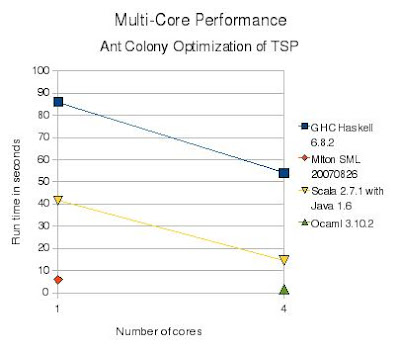
Erlang and Alice SML omitted from graph. Note change from previous tests: 1000 interations, instead of 100. Still 200 cities.

Cores Erlang Haskell Scala OCaml MLton Alice
SML SML
1 372 86 41.6 6.0 676
2 192 63
3 141 58
4 98 54 14.6 1.6

All times in seconds.

If anyone knows how to reduce the number of cores used by the JVM, I'll fill in the rest of the table for Scala.

Tuesday, June 3, 2008

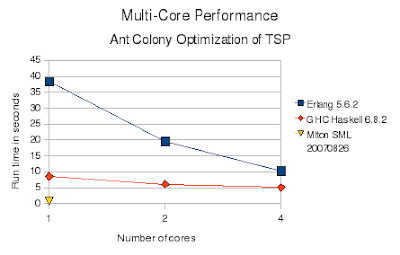
Functional Languages on Quad-Core (revised)

Yesterday's post generated lots of suggestions. I've revised the Erlang code to use dict mapping and updating functions. I didn't use the new Erlang arrays since they are one-dimensional and I need two dimensional arrays. Here are the new results:


Cores Erlang Haskell SML
1 38.4 8.6 0.76
2 19.6 6.1
3 14.5 5.5
4 10.3 5.1

Here is the revised Erlang source code, as well as the Haskell quad-core source code used in tests. The MLton Standard ML implementation is still single-core, as MLton does not have SMP support (see comments below).

Update: Added new post with Scala implementation.

Sunday, June 1, 2008

Functional Languages on Quad-Core

In an earlier series of articles ending with Multi-Core Ant Colony Optimization for TSP in Erlang I evaluated the performance of the Standard ML, Haskell, and Erlang functional programming languages using a test problem of solving the traveling salesman problem using ant colony optimization. At the time I only had available a dual-core machine. I have re-run the tests using an Intel quad-core machine and the latest language versions available for Debian Linux.
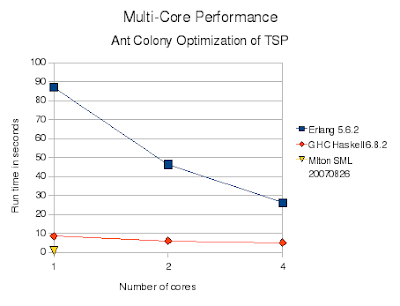


The results match my previous summary: Erlang is much slower than the others. Erlang is a bytecode interpreted virtual machine while the others are native code compilers. Erlang is also dynamically typed while the others are statically typed. Like Haskell, Erlang has immutable (single assignment) variables which force lots of copying. Unlike Standard ML and Haskell, no array type is provided so I had to inefficiently implement them using dictionaries. In Erlang each process (thread) does have a separate heap, so there is little interference between processes due to memory allocation or garbage collection. Near perfect speedup is achieved.
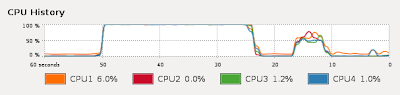


The CPU utilization graph (Erlang, then Haskell, then Standard ML) does show the lack of interference between Erlang threads which makes its speedup possible. Haskell achieves little speedup at higher numbers of cores.

Update: thanks, responses to comments:

As discussed at the end of an earlier posting, based on email feedback I did try HiPE compilation with Erlang 5.5 on AMD. It provided no significant improvement, and was not compatible with multi-core operation. This time I again tried HiPE compilation with Erlang 5.6.2, and get the following with erl:

$erl
Erlang (BEAM) emulator version 5.6.2 [source] [smp:4]
[async-threads:0] [kernel-poll:false]

Eshell V5.6.2 (abort with ^G)
1> c(ant,[native]).
./ant.erl:none: Warning: this system is not configured for
native-code compilation.
{ok,ant}
2>

Same for erlc:

$erlc +native ant.erl
./ant.erl:none: Warning: this system is not configured for
native-code compilation.

So it appears the latest i386 Erlang available from Debian Linux apt-get doesn't support native compilation, probably because they chose to enable SMP support instead.

Erlang arrays are new in the latest release. Thanks for the info, I'll try them out.

Yes, MLton SML with one core was the fastest. Older (pre-quad-core) versions of the code are available linked from the various ACO TSP pages and here: Standard ML, Haskell, Erlang.

Actually the next language I will probably try is Scala. Based on the Java JVM, it may inherit JIT native compilation and good SMP thread support. It also supports an Actor concurrency model like Erlang. Apparently Caml dialects don't support SMP. Of course for many problems (like ACO TSP :-) you are better off simply starting N different fast single-threaded instances of the program and collecting the results in Ruby or some-such. I am really looking for instances where using a SMP-capable language is a clear win over single-threaded C++. I haven't written a single-threaded STL C++ version of ACO TSP; I expect it could easily crush Mlton SML once you finally got the bugs out...

Here are the raw numbers, in seconds:

Cores Erlang Haskell SML
1 87.0 8.6 0.76
2 46.3 6.1
3 34.6 5.5
4 26.2 5.1

When I increase the iterations in Haskell by 5x the runtime goes up by 5x (43 secs with 1 core, 26 secs with 4 cores), still showing the same pattern of decreasing improvement with increased cores.

Update 2: see new post for revised Erlang code and results.

Update 3:
Turns out Erlang HiPE is available in Debian as a separate package (erlang-base-hipe), and is now SMP compatible. But the improvement is only 5%, or 11% if you also native compile dict.erl.
Sunday, May 18, 2008

What I.D. is really about

My earlier post Life is like Javascript, not like Java discussed the conflict between Plato's theory of Forms and evolution of new species [*]. I think this conflict is the real motivator behind Intelligent Design. The idea of Forms is pre-Plato; it is implied in Genesis in the animal Kinds and is actually part of our early cognitive heritage. For Plato the belief in Forms both presupposed and necessitated a deity.

The IDers believe in Platonic Forms (often without realizing it), and view species as Forms. They believe natural processes like evolution cannot produce new Platonic Forms, since the Forms preexist and reside in some other timeless dimension our minds somehow contact. Space aliens (an alternative proposed by the IDers in my earlier post Did the First Giraffe have a Navel?) are also unlikely to be able to add new Platonic Forms. The only viable alternative is a deity, the same one who set the mathematical and physical constants (like Pi, and the speed of light C) before the universe was created. The species Forms would have also all been predefined before the universe started.

[*] Note this summary also slides towards a common trap, not unique to IDers. My linked post also asserts species don't really exist, but are an arbitrary man-made construct. So in an important sense evolution doesn't produce species, only individuals. The IDers are asserting nature is bounded by preexisting species Forms, while I say nature in generating new individuals does not recognize or respect any such boundaries.

Tuesday, May 13, 2008

Why many of us dislike Pair Programming

From Extraversion and introversion on Wikipedia:

An extravert is energized when around other people. Extraverts tend to "fade" when alone and can easily become bored without other people around. Extraverts tend to think as they speak. When given the chance, an extravert will talk with someone else rather than sit alone and think...

An introvert is energized when alone. Introverts tend to "fade" when with people and can easily become overstimulated with too many others around...

Acting, teaching, directing, managing, brokering are fields that favor extraversion...

(Introverts) often take pleasure in solitary activities such as reading, writing, drawing, watching movies, and using computers. The archetypal artist, writer, sculptor, composer and inventor are all highly introverted...

Some careers such as computer programming may be more satisfying for an introverted temperament, while other areas such as sales may be more agreeable to the extraverted type.

Sunday, May 4, 2008

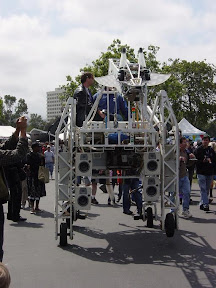
Maker Faire 2008


A bit more Burning Man,


a bit more Love Parade,


a bit more Disney.


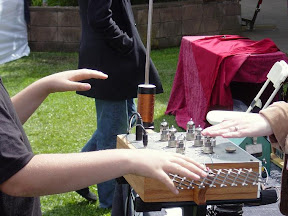
The Theremin by the Steampunk section was cool.

Sunday, April 27, 2008

Waking Life

Kant says somewhere: "The lunatic is a dreamer in the waking state." According to Krauss, "Insanity is a dream in which the senses are awake." Schopenhauer terms the dream a brief insanity, and insanity a long dream. Hagen describes delirium as a dream-life which is inducted not by sleep but by disease. Wundt, in his Physiologische Psychologie, declares: "As a matter of fact we ourselves may in dreams experience almost all the manifestations which we observe in the asylums for the insane."

Sigmund Freud, The Interpretation of Dreams, p. 66.