My earlier post Life is like Javascript, not like Java discussed the conflict between Plato's theory of Forms and evolution of new species [*]. I think this conflict is the real motivator behind Intelligent Design. The idea of Forms is pre-Plato; it is implied in Genesis in the animal Kinds and is actually part of our early cognitive heritage. For Plato the belief in Forms both presupposed and necessitated a deity.
The IDers believe in Platonic Forms (often without realizing it), and view species as Forms. They believe natural processes like evolution cannot produce new Platonic Forms, since the Forms preexist and reside in some other timeless dimension our minds somehow contact. Space aliens (an alternative proposed by the IDers in my earlier post Did the First Giraffe have a Navel?) are also unlikely to be able to add new Platonic Forms. The only viable alternative is a deity, the same one who set the mathematical and physical constants (like Pi, and the speed of light C) before the universe was created. The species Forms would have also all been predefined before the universe started.
[*] Note this summary also slides towards a common trap, not unique to IDers. My linked post also asserts species don't really exist, but are an arbitrary man-made construct. So in an important sense evolution doesn't produce species, only individuals. The IDers are asserting nature is bounded by preexisting species Forms, while I say nature in generating new individuals does not recognize or respect any such boundaries.
Sunday, May 18, 2008

Tuesday, May 13, 2008
Why many of us dislike Pair Programming
From Extraversion and introversion on Wikipedia:
An extravert is energized when around other people. Extraverts tend to "fade" when alone and can easily become bored without other people around. Extraverts tend to think as they speak. When given the chance, an extravert will talk with someone else rather than sit alone and think...
An introvert is energized when alone. Introverts tend to "fade" when with people and can easily become overstimulated with too many others around...
Acting, teaching, directing, managing, brokering are fields that favor extraversion...
(Introverts) often take pleasure in solitary activities such as reading, writing, drawing, watching movies, and using computers. The archetypal artist, writer, sculptor, composer and inventor are all highly introverted...
Some careers such as computer programming may be more satisfying for an introverted temperament, while other areas such as sales may be more agreeable to the extraverted type.
An extravert is energized when around other people. Extraverts tend to "fade" when alone and can easily become bored without other people around. Extraverts tend to think as they speak. When given the chance, an extravert will talk with someone else rather than sit alone and think...
An introvert is energized when alone. Introverts tend to "fade" when with people and can easily become overstimulated with too many others around...
Acting, teaching, directing, managing, brokering are fields that favor extraversion...
(Introverts) often take pleasure in solitary activities such as reading, writing, drawing, watching movies, and using computers. The archetypal artist, writer, sculptor, composer and inventor are all highly introverted...
Some careers such as computer programming may be more satisfying for an introverted temperament, while other areas such as sales may be more agreeable to the extraverted type.
Sunday, May 4, 2008
Maker Faire 2008

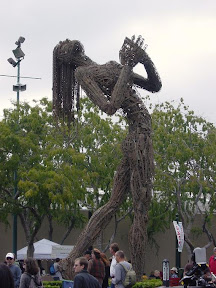
A bit more Burning Man,
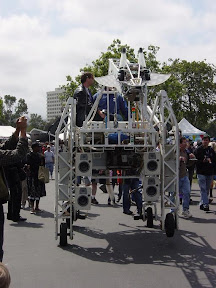
a bit more Love Parade,

a bit more Disney.
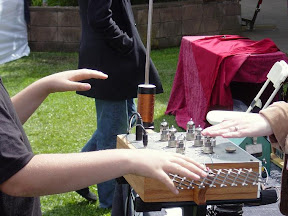
The Theremin by the Steampunk section was cool.
Sunday, April 27, 2008
Waking Life
Kant says somewhere: "The lunatic is a dreamer in the waking state." According to Krauss, "Insanity is a dream in which the senses are awake." Schopenhauer terms the dream a brief insanity, and insanity a long dream. Hagen describes delirium as a dream-life which is inducted not by sleep but by disease. Wundt, in his Physiologische Psychologie, declares: "As a matter of fact we ourselves may in dreams experience almost all the manifestations which we observe in the asylums for the insane."
Sigmund Freud, The Interpretation of Dreams, p. 66.
Sigmund Freud, The Interpretation of Dreams, p. 66.
Saturday, April 5, 2008
Black Swans in the Market
Modern portfolio theory is based on the assumption that changes in stock prices are normally distributed (follow a bell curve). Benoit Mandelbrot and Nassim Nicholas Taleb disagree with this assumption, and believe market crashes like that of 1987 are much more likely to occur than standard theory predicts.
For my spring 2006 U.C. Berkeley Extension Statistics class I created a presentation Are Daily Changes in Stock Prices Normally Distributed? I analyzed MSFT (used in the standard MBA Finance textbook as an example of normality!), BRKA, and the S&P 500 index over various date ranges. I found none of them satisfied statistical tests for normality.
For my spring 2006 U.C. Berkeley Extension Statistics class I created a presentation Are Daily Changes in Stock Prices Normally Distributed? I analyzed MSFT (used in the standard MBA Finance textbook as an example of normality!), BRKA, and the S&P 500 index over various date ranges. I found none of them satisfied statistical tests for normality.
Black Swans
"Black Swans", as unlikely or unexpected economic events, are currently in the news. This usage was popularized by Nassim Nicholas Taleb. It was based on the old European belief that all swans were white, which was contradicted by the discovery of black swans in Australia. But as I discussed earlier genus and species are human-defined categories. There is no logical contradiction inherent in a black swan, and probabilities related to finding one are really probabilities of finding individuals (animal instances) fitting into ill-defined categories.
Note the first black swan was discovered in 1697, over 150 years before publication of Darwin's On the Origin of Species (1859) and over 250 years before Watson and Crick's A Structure for Deoxyribose Nucleic Acid (DNA) (1953). So seventeenth century notions of species would not include modern concepts of evolutionary descent or DNA similarity. Instead they were based on ideas of fixed categories inherited from Aristotle.
Note the first black swan was discovered in 1697, over 150 years before publication of Darwin's On the Origin of Species (1859) and over 250 years before Watson and Crick's A Structure for Deoxyribose Nucleic Acid (DNA) (1953). So seventeenth century notions of species would not include modern concepts of evolutionary descent or DNA similarity. Instead they were based on ideas of fixed categories inherited from Aristotle.
Progress in GPGPU Ray Tracing
I've been getting traffic and questions about my pages on Cell and CUDA ray tracing. Saarland University has been doing some interesting work on Cell and CUDA ray tracing including this paper: Realtime Ray Tracing on the GPU with BVH-based Packet Traversal.
Subscribe to:
Posts (Atom)